
Stainless Steel Profiles Expand Application Scope as Spiral Anchor Market Sees Structural Growth
Release time:
2026-08-04
Stainless Steel Profiles Expand Application Scope as Spiral Anchor Market Sees Structural Growth
BEIJING — The construction industry's demand for stainless steel profiles is undergoing a structural shift. Industry observers note that the application boundary of stainless steel profiles has accelerated beyond traditional industrial support into multiple sectors including building structures, underground foundations, curtain wall decoration, and green construction. In niche segments such as helical anchors and prefabricated components, some companies have reported year-on-year order growth exceeding 30%.
Optimized Cross-Section Design Drives Adoption in Long-Span Architecture
Stainless steel profiles (angles, channels, I-beams, Z-purlins, etc.) achieve higher section modulus and bending resistance through optimized cross-section geometry while significantly reducing self-weight. Journalists learned that in long-span spatial structure projects such as airport terminals, sports stadiums, and convention centers, the adoption rate of stainless steel profile components continues to rise.
Compared with ordinary carbon steel, stainless steel profiles maintain long-term corrosion resistance in humid, coastal, or industrial pollution environments without additional protective coatings, with service life reaching 3 to 5 times that of ordinary steel and markedly lower lifecycle maintenance costs. The gradual adoption of high-strength duplex stainless steel grades such as 2205 and 2505 has further expanded their application space in modular construction.
Spiral Anchors Gain Traction Quietly, Offering New Alternative for Underground Foundation Construction
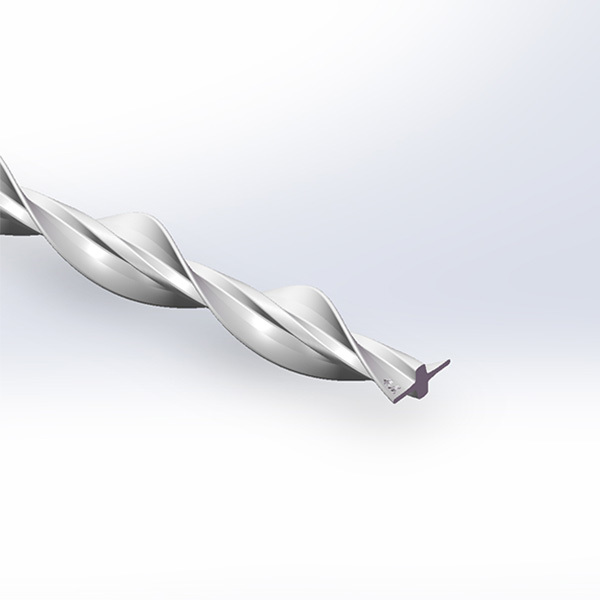
Notably, stainless steel spiral anchors, as an extension of profile applications, are rapidly penetrating the building foundation sector. Industry sources indicate that spiral anchors achieve rapid foundation construction by screwing into the ground and leveraging bearing capacity from helical blades, eliminating the need for large-scale excavation and concrete curing, with construction completion and load-bearing achievable immediately—reducing project timelines by over 50%.
In complex geological conditions such as soft soil, backfill, and frozen ground, stable bearing capacity can be flexibly achieved by adjusting the number of helical blades and anchor rod length. Industry insiders point out that this characteristic gives spiral anchors unique advantages in urban redevelopment projects, prefabricated building foundations, underground utility corridor support, and photovoltaic bracket foundations. Some construction enterprises in the Yangtze and Pearl River Delta regions have already included them in standard foundation solutions.
Additionally, disassembly and recovery stands as another core advantage. Temporary or emergency facilities can have spiral anchors directly extracted and reused after demolition, substantially reducing construction waste generation and aligning with current green building circular economy principles.
Curtain Wall Decoration Demand Steady; Green Building Rating Bonus Effect Gains Attention
In building curtain wall and interior decoration, demand for stainless steel profiles (T-bars, U-channels, L-trim strips, etc.) maintains stable growth. Due to their ability to be processed into complex cross-sections and support various surface treatments (brushed, mirror, sandblasted, PVD-coated), their visual compatibility with glass, stone, and aluminum panels offers rich design possibilities, earning favor among architects.
Industry analysts point out that stainless steel profiles hold multiple scoring advantages under green building certification systems: near-100% recyclability, long service life, high residual value after demolition, and ongoing low-carbon process transformation on the production side. Under LEED and China's Green Building Evaluation Standard rating systems, the use of high-recyclability and long-life materials can earn corresponding environmental bonus points, further incentivizing developers and designers to specify these materials.
Overall, stainless steel profiles are transitioning from a single-purpose industrial material to a multi-scenario foundation material for construction. The rapid emergence of the spiral anchor market, sustained penetration of prefabricated construction, and improving green building standards may jointly drive this material category into a new growth cycle.
More news



Contact Us
E-mail:
Wechat:+8613365215016
WhatsApp: +8613365215016
Address:B3-01, Zhangguo Town Science and Technology Park, Xinghua City, Taizhou City, Jiangsu Province
Copyright:Innovate Wirerod (Taizhou) New Materials Co., Ltd.

Message