

The difference between 316 and 316L in stainless steel
Release time:
2021-11-18
Although 316 stainless steel and 316L stainless steel literally have only one letter difference, in fact they still have many differences. Today, the editor of Taizhou Taisheng Stainless Steel Products Co., Ltd. talks about the difference between 316 stainless steel and 316L stainless steel in terms of production cost, tensile strength, yield strength, corrosion resistance, welding treatment, scope of use and practical application.
Although 316 stainless steel and 316L stainless steel literally have only one letter difference, in fact they still have many differences. Today, Taizhou Taisheng Stainless Steel Products Co., Ltd. of the small editor will give you a simple chat about the difference between 316 stainless steel and 316L stainless steel.
1, the difference between production costs
316 L stainless steel has low carbon content and is an ultra-low carbon stainless steel. It is convenient to weld. Therefore, the price of 316 L stainless steel is more expensive than 316 stainless steel, but the difference is not big. In addition, 316 L stainless steel can also be called low carbon steel plate 316 stainless steel. And 316 stainless steel is low carbon stainless steel.
2. The difference in tensile strength
The tensile strength of 316 stainless steel pipe is higher than that of 316 L stainless steel pipe. The tensile strength of 316 stainless steel is higher than that of 316 L stainless steel pipe, generally higher than 520 MPa, while the tensile strength of 316 stainless steel is only greater than 480 Mpa. This is because carbon is a strong austenite forming element, can significantly improve the strength of stainless steel. The carbon content of 316L stainless steel is lower than that of 316 stainless steel, so the tensile strength is lower than that of 316 stainless steel.
3, the difference in yield strength
The yield strength is the yield limit of the metal material when the yield phenomenon occurs, that is, the stress that resists the slight plastic deformation. For metal materials without obvious yield, the stress value that produces 0.2% residual deformation is specified as its yield limit, which is called the conditional yield limit or yield strength. An external force greater than this limit will cause the part to fail permanently and cannot be restored. If the yield limit of 316 stainless steel is 205MPa, when the external force greater than this limit is applied, the part will produce permanent deformation, and if it is less than this, the part will return to its original appearance. The yield strength of 316 stainless steel is 205Mpa, and the yield strength of 316L stainless steel is 170Mpa.
4, the difference between corrosion resistance
316 L stainless steel has stronger corrosion resistance and is suitable for strong corrosion areas such as seaside.
5, the difference between welding treatment
Carbon has a negative effect on the corrosion resistance of stainless steel. Especially for stainless steel that needs to be welded, the corrosion resistance of low-carbon 316 L stainless steel after welding is higher than that of 316 stainless steel. 316 stainless steel welded sections need to be solution annealed after welding. If 316 L stainless steel is used, solution annealing after welding is not required.
6, the use of the scope of the difference
In most cases, 304 stainless steel is sufficient for the application. Due to the high price of 316L stainless steel pipe, from the material cost point of view, the use of 304 stainless steel is about 1.5 times that of 316L stainless steel.
7, the practical application of the difference
The corrosion resistance and high temperature strength of 316 stainless steel are greatly improved due to the addition of Mo element. The corrosion resistance is better than 304 stainless steel, and it has good corrosion resistance in the production process of pulp and paper. And 316 stainless steel is also resistant to marine and aggressive industrial atmosphere. Mainly used for: seawater equipment, chemical, dye, paper, oxalic acid, fertilizer and other production equipment; photography, food industry, coastal facilities, ropes, CD rods, bolts, nuts.
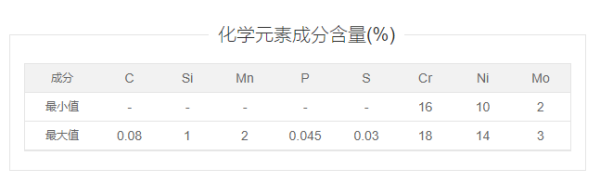
The chemical composition of 316 stainless steel is as follows:
316L stainless steel is commonly used in pulp and paper equipment, heat exchangers, dyeing equipment, film processing equipment, pipes, coastal areas, external materials for buildings, and high-end watch chains, watch cases, etc. Seawater equipment, chemical, dye, paper, oxalic acid, fertilizer and other production equipment; photography, food industry, coastal facilities, ropes, CD rods, bolts, nuts.
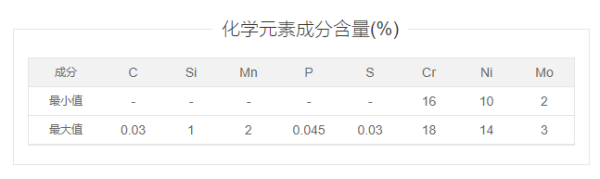
The chemical composition of 316L is as follows:
The above is a summary of the difference between 316 stainless steel and 316L stainless steel, hoping to be helpful to everyone.
Previous Page
More news



Contact Us
E-mail:
Wechat:+8613365215016
WhatsApp: +8613365215016
Address:B3-01, Zhangguo Town Science and Technology Park, Xinghua City, Taizhou City, Jiangsu Province
Copyright:Innovate Wirerod (Taizhou) New Materials Co., Ltd.

Message